18-Wheeler Accident Lawyers
Were You Injured in An 18-Wheeler Accident?
Commercial truck accidents often have deadly consequences. Because of their size and weight, 18-Wheelers and semi-trucks cause some of the most devastating injuries and deaths each year.
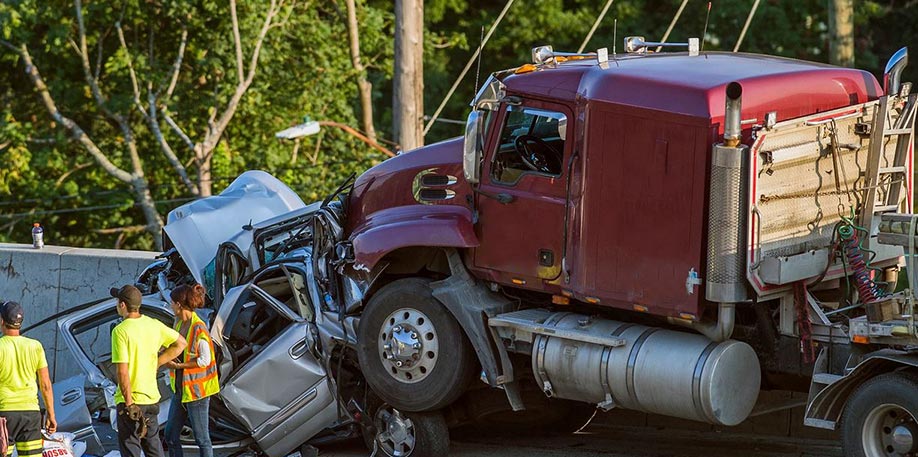
In 2022, the Federal Motor Carrier Safety Administration estimated around 81% of injury cases involved 18-wheelers or other commercial vehicles. Another 2023 report suggested that these vehicles account for 9% of all fatal car accidents in the United States.
Sadly, these types of accidents are far more likely to kill innocent passengers who had no control over the wreck. Over the past two decades, the U.S. Department of Transportation has noted a 52% rise in deaths from 18-wheeler accidents.
Many devastating trucking accidents are easily preventable. Commercial 18-wheeler drivers make crashes more likely when they neglect traffic laws and drive recklessly. Trucking companies also contribute when they fail to thoroughly train drivers, neglect safety policies, or conduct improper hiring practices.
When Texas drivers face catastrophic injuries from negligence on the road, an 18-wheeler accident lawyer can help them pursue justice. Our top rated personal injury attorneys specialize in representing victims of preventable accidents, including negligent 18-wheeler crashes.
We Are the Leaders in Truck Accident Litigation
Miller Weisbrod Olesky has recovered more than $1.3 Billion in settlements for clients injured in all kinds of ways. We have represented victims of 18-wheeler crashes, construction accidents, medical malpractice, and families who lost loved ones to wrongful death.
Board-Certified 18-Wheeler Attorneys

Board-Certified Personal Injury Trial Lawyer Clay Miller leads our 18-Wheeler Accident Lawyer team. He is one of less than 7% of all Texas attorneys who have achieved board certification in any field of law. Even fewer attorneys hold the distinction of board certification in personal injury trial law.
Our 18-wheeler accident lawyers are experienced in trucking regulations and the various computerized equipment that accompany these vehicles. We know about the specific and detailed safety regulations that truck drivers and trucking companies must adhere to.
We regularly speak at legal conferences to share our expertise in these complex commercial trucking wrecks with other attorneys.
If you or someone you know sustained injuries from a preventable 18-wheeler wreck, don’t hesitate to contact our firm. We are happy to assist you with a free consultation and legal review of your potential case. We also work on a contingency fee basis, meaning you don’t pay any fees until after we win your case. We only receive payment once you do.
Over the years, Miller Weisbrod Olesky has built up an impressive track record of legal victories that speaks for itself.
Examples of our 18-Wheeler Accident settlements include
$8,750,000.00 - We represented the families of two individuals who were killed by a truck driver who fell asleep at the wheel of his semi truck following his Christmas holidays.
$7,000,000.00 - Our client was hit head on by a company truck. Her vascular system was badly damaged and over the course of a month her lower leg’s blood flow was so compromised that serious gangrene set in leading to an amputation.
$6,000,000.00 - $6 million for the family of a female driver killed by a distracted truck driver.
What Is an 18-Wheeler?
An 18-wheeler is typically a combination of a tractor unit and one or more semi-trailers to carry commercial cargo.
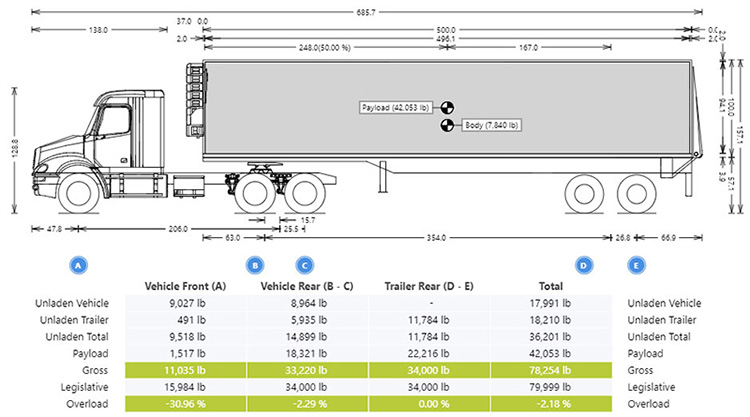
With a full load, a standard 18-wheeler can weigh up to 80,000 lbs. These tractor trailers have five axles and are usually about 70 ft. long and 13½ ft. tall.
But 18-wheelers hauling oversized cargo may be much longer, higher, and heavier. Drivers need up to 50% more distance to make a complete stop after braking. The turning radius of 18-wheelers is also huge compared to passenger cars. These are the risks that make injury and fatality more likely in a wreck involving one of these oversized vehicles.
Which Texas Highways See the Most 18-Wheeler Accidents?
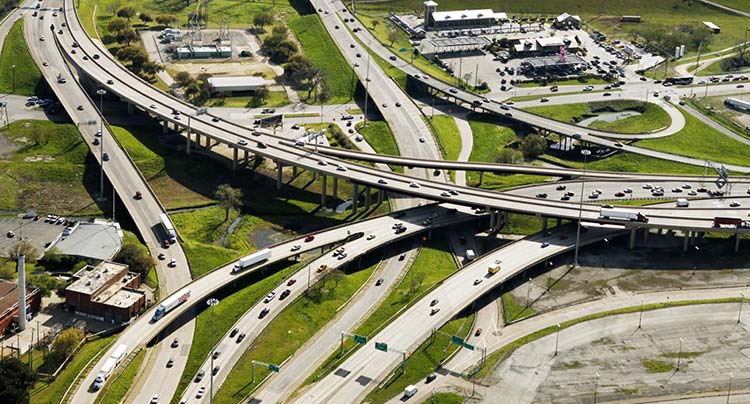
Texas is famous for its extensive road network. While most highways in the Lone Star State are safe, some have gained notoriety for their higher incidence of accidents. The most dangerous roads and highways in Texas for 18-wheeler accidents include:
- Interstate 45 (I-45): Stretching from Houston to Dallas, I-45 has earned a reputation for accidents, particularly in urban areas. Congestion, construction zones, and heavy commuting traffic all contribute to the risks.
- Interstate 35 (I-35): As one of the busiest highways in Texas, I-35 connects cities like Dallas, Austin, and San Antonio. It faces issues like traffic congestion, construction, and frequent lane changes.
- Interstate 10 (I-10): Running from the Louisiana border to El Paso, I-10 traverses vast expanses of Texas. Its length and frequent use make it susceptible to accidents, especially during inclement weather.
- US Highway 290: Serving the Houston metropolitan area, US 290 sees a significant number of accidents each year. With over 2.3 million Houston residents, high traffic volumes and ongoing construction projects contribute to the road’s danger.
- US Highway 183: Running through Austin, US 183 has seen an uptick in accidents from rapid urban development and increased traffic.
- Highway 183 (Airport Freeway): Running through Dallas-Fort Worth, Highway 183 faces congestion and construction-related challenges.
- State Highway 360 (SH 360): Connecting the Dallas-Fort Worth area, SH 360 is often congested during rush hours. This contributes to a higher likelihood of accidents.
- Loop 410: Encircling San Antonio, Loop 410 witnesses frequent accidents due to heavy commuter traffic.
- Loop 610: The inner loop around Houston, Loop 610 experiences congestion, complex interchanges, and a higher risk of accidents.
- Farm-to-Market 1960 (FM 1960): Located in the Houston area, FM 1960 has gained notoriety for heavy traffic. A 2025 investigation from the Washington Post listed FM 1960 as a notable “pedestrian death zone”.
The Importance of Contacting Legal Help Early
In a recent case, a Miller Weisbrod Olesky client ran into the back of an 18-Wheeled rock hauler. The vehicle suddenly pulled from the tollway median, interrupting traffic flow and cutting off our client abruptly without warning. Our client slammed into the back of the 18-Wheeled rock hauler, suffering serious injuries that required transportation to the hospital.
The truck driver was the only witness the investigating officer spoke with and put the blame on our client. His “story” was that he was already “established” in his lane. He claimed our client hit him after “swerving in an attempt to pass a white box truck.”
Luckily, our 18-Wheeler Accident Lawyers got to work soon after the accident. We obtained the video from the Tollway authority and located the witness who called 911 right after the incident. As seen in the video above, the truth came out. If our client had not contacted us early, the video would likely have been “lost” or “unrecoverable.”
What Are Common 18-Wheeler Accidents?
A collision with an 18-wheeler can happen in a multitude of different ways, depending on the circumstances. The most common types that our 18-wheeler accident lawyers regularly encounter are:
18-Wheeler Jackknife Accidents
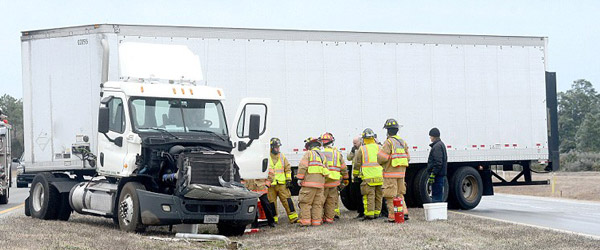
A jackknife accident happens when the trailer and cab skid in opposite directions. The trailer appears to fold on a hinge and comes to rest at an angle to the cab. The skidding of the trailer stops only when the tractor and the trailer are at a 90-degree angle.
During this skid, the driver does not have any control over the truck. The 18-wheeler will drag along any vehicle that gets stuck in this 90-degree angle. The truck generally tends to roll over after it comes to a stop.
In 2020, jackknife accidents caused over 1000 injury crashes and claimed around 169 lives in the United States.
18-Wheeler Rollover Accidents
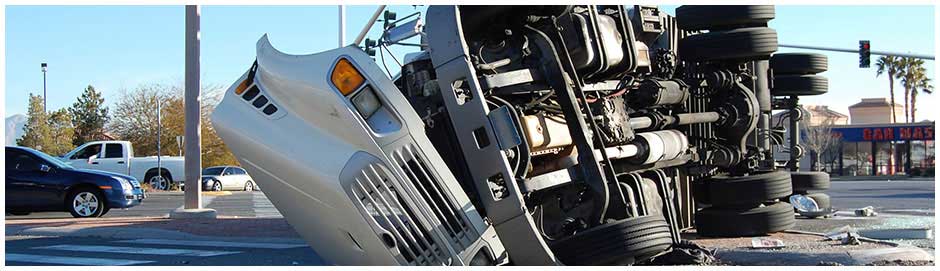
Because of their high center of gravity, it’s not uncommon for 18-Wheelers to roll over when a driver loses control.
Trucks may roll over for any of the following reasons:
- High speed followed by sudden braking
- Attempting steep inclines or declines
- Taking a turn too fast or jerking the wheel too hard
- Tripping over a curb
- Attempting to correct a drifting truck
- An unexpected obstruction on the road
An 18-wheeler or tractor-trailer is 40-times heavier than the average passenger vehicle on the road. A rollover accident can have disastrous consequences for the driver as well as any vehicle stuck underneath the truck. Passengers in cars, pickups, or SUVs will likely sustain severe or fatal injuries if the rig rolls onto their vehicles.
18-Wheeler Tire Blowout Accidents
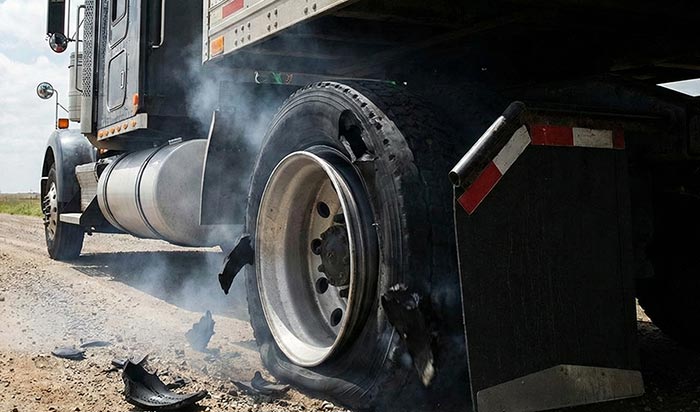
Tire blowouts can force an 18-Wheeler vehicle out of its lane and into the path of other cars. Many semi-truck tire blowouts occur because the driver or the trucking company failed to conduct regular inspections.
Federal regulations mandate that trucking companies regularly inspect and maintain their vehicles, including the tires. Blowouts are far more likely when these companies fail to maintain or replace their tires as needed.
18-Wheeler Rear-End Collisions
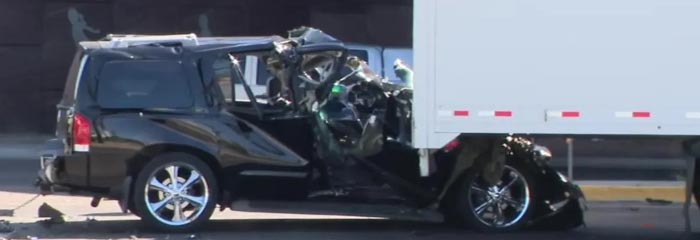
An 18-wheeler or semi-truck requires up to 50% more room to stop than a typical passenger vehicle. If the driver miscalculates their stopping distance, they may rear-end the vehicle in front of them.
Rear-end collisions often occur because a truck driver was following another vehicle too closely. This can happen when they speed, drive distracted or fatigued, or when they have faulty brakes that needed further inspection.
18-Wheeler Underride Accidents
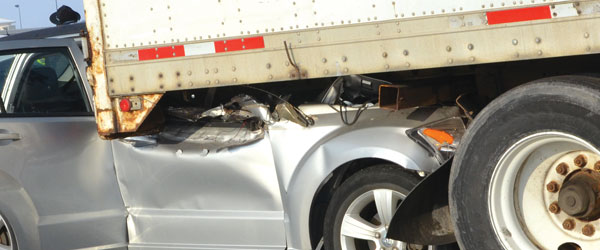
The Federal Motor Carrier Safety Administration (FMCSA) requires all commercial 18-wheelers, tractor-trailers and big rigs to have underride protection. This means installing metal guardrails on the sides and back of the vehicle's undercarriage. Having these guards helps prevent vehicles from slipping underneath the trailer in the event of an 18-wheeler accident.
Failure to provide underride protection can result in catastrophic injuries to occupants of other motor vehicles.
Trucking Industry Continues to Ignore Side Underride Guards
The National Highway Traffic Safety Administration (NHTSA) has yet to establish regulations mandating underride guards on the sides of 18-wheelers. Because of this, many companies in the trucking industry continue to disregard the implementation of side underride guards. The American Truckers Association openly opposed a 2019 bill proposing underride guard mandates for vehicles hauling over 10,000 lbs. In their letter to Congress, they decried underrides as “expensive and unproven collision mitigation equipment.” These sentiments go against other research on underride accidents from the Institute for Highway Safety (IHS).
18-Wheeler T-Bone Accidents
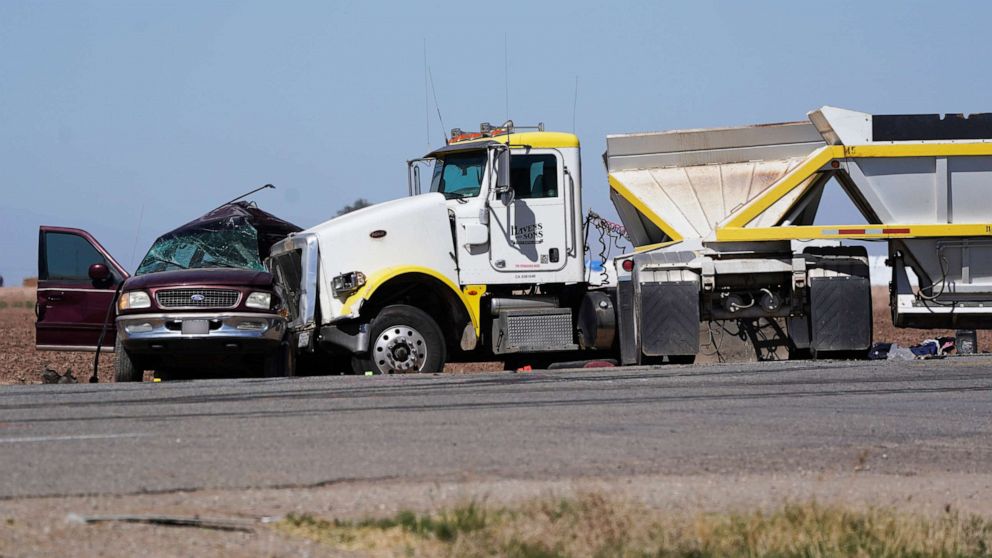
T-bone accidents occur when an 18-wheeler collides with the side of another vehicle. These types of crashes are likely to happen when:
- The trucker runs through a red light or a stop sign at an intersection
- The trucker fails to yield the right of way
- The trucker drives while impaired, distracted, or fatigued
When an 18-wheeler T-bones another car, the occupants of the smaller vehicle usually take on the full impact. This frequently leads to catastrophic and even fatal injuries.
Any accident involving an 18-wheeler has the potential to cause devastating injuries. Contacting an 18-wheeler accident lawyer as soon as possible can give victims the best chance at recovering damages after the crash.
What Are Common Injuries of 18-Wheeler Accidents?
Injuries in an 18-wheeler accident are typically more severe and life-threatening than the average collision. Some of the most common serious injuries our clients face from these accidents include:
Traumatic Brain Injuries

Head trauma from an 18-wheeler accident can sometimes injure the victim’s brain. The consequences of a Traumatic Brain Injury (TBI) can range from mild to fatal.
Damage to the brain can result in concussions, comas, and sometimes permanent cognitive and physical disabilities. Extreme cases involving brain bleeds and hemorrhaging can result in death.
Victims sometimes fail to immediately recognize their TBI when more visible injuries are present (like broken bones or burns). This can lead to missed diagnoses and delays in critical treatment.
Victims should stay alert for signs of TBIs like memory loss, confusion, and sensory changes after the crash. Our 18-Wheeler accident attorneys regularly assist clients in obtaining the necessary expert medical evaluation to diagnose a traumatic brain injury.
Spinal Cord Injuries
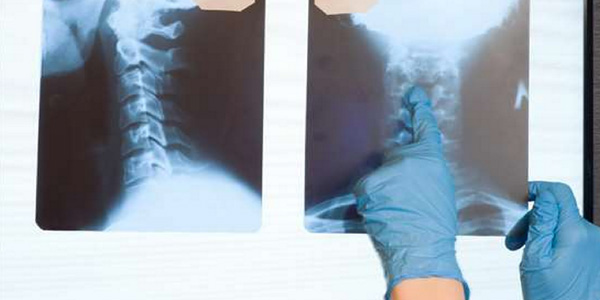
A spinal cord injury from an 18-wheeler accident can cause intense pain and permanent physical disabilities. Injury to the middle or lower part of the back can lead to immobility in the legs. Spinal injuries in the neck are even more serious with the potential to immobilize all limbs (quadriplegia).
The most common spinal injuries include disc herniations, compression fractures, and nerve root compression. These injuries may require epidural steroid injections (ESIs) or back and neck surgery (laminectomy, fusion or disc decompression or replacement).
It is important that clients receive guidance regarding the proper medical care for injuries to the spine and surrounding structures. Our 18-Wheeler accident attorneys advise clients on the full course of treatment options to help them make the best recovery.
Fractures & Orthopedic Injuries
The significant amount of force exerted in 18-wheeler accidents often results in broken bones. Trucking accidents most commonly fracture the victim’s clavicle (collarbone), ribs, legs, pelvis, arms, and wrists.
While bone fractures are luckily some of the most treatable injuries, they can still significantly impact a victim’s recovery journey. They will likely undergo orthopedic surgery in the hospital and have the injured area immobilized in a cast or splint. They may need to wear this for several months.
Victims with serious breaks (particularly in the legs) will undergo intensive physical therapy to restore strength and mobility. Our 18-Wheeler accident attorneys help clients access these treatments and secure the necessary funds to afford them.
Crush Injuries
A crush injury occurs when the victim’s body becomes lodged or squeezed between two heavy objects. Internal crush injuries can vary from compressed nerves to broken bones to crushed organs. The symptoms of these injuries can also vary from excruciating pain to numbness to a feeling of rushing fluids.
Many of these injuries require expensive medical procedures and multiple surgeries to correct (if treatable at all). Often, these injuries cause irreversible damage and leave families with lifelong medical expenses and caring for someone with permanent disabilities.
Wrongful Death
A wrongful death occurs when an individual needlessly dies from the negligence, inaction or malice of another party.
Accidents happen every day, but individuals or companies are at fault when they don’t take necessary precautions to avoid them. Tragically, most of the fatalities our 18-wheeler accident attorneys assess are preventable. We may find a person or company liable for wrongful death if they’re at least partially responsible for the accident.
What Should I Do Right After an 18-Wheeler Accident?
Your health and safety are the main priorities immediately following an 18-wheeler accident.
Call 911
When you’ve been in an 18-wheeler accident, it is important to obtain any possible police reports. When the police arrive on scene, be sure to provide a detailed and accurate version of what happened. Do not make any comments that may lead to a misunderstanding of fault.
Get Medical Help
Medical personnel will make a quick assessment of your state upon their arrival at the accident. They may ask you questions about different areas of your body or conduct a field test for concussions.
If first responders on the scene suggest you go to the hospital, listen to them. Symptoms can take several days to surface; it’s best to get a head start on diagnosing any possible injuries.
Gather Information
If you are able, make sure to get contact and insurance information from all parties involved with the accident. If you or someone you are with can take pictures of the accident, include the following helpful images:
- Road Conditions (wet, dry, icy, etc.)
- Tire Marks
- Damage to all vehicles involved
- Street Names / Highway Mile Markers
- License Plates of vehicles involved (if possible)
If there are any witnesses or bystanders, try and collect their contact information. This can be useful when attempting to determine the cause or fault of the accident.
What Are The Rules and Regulations of Driving an 18-Wheeler?
Operating any commercial vehicle in the United States comes with strict rules and regulations. These can include:
FMSCA Regulations
The Federal Motor Carrier Safety Administration (FMCSA) implements and enforces regulations for all commercial vehicles operating in the United States. This includes 18-wheeler semi-trucks, hazardous materials (hazmat) trucks, tanker trucks, flatbeds trucks, buses, commercial delivery trucks, and more. These regulations include:
- Licensing: All commercial truckers must have the proper commercial driver’s license (CDL) and training for that vehicle. Each CDL requires training and examinations.
- Health conditions: Approved healthcare providers must assess CDL applicants to medically clear them for operating the vehicle.
- Truck inspections: By law, drivers must inspect certain aspects of their truck’s pre-shift. Companies are responsible for inspecting and maintaining the trucks in their fleet (and documenting it in writing).
- Size and weight: The FMCSA sets strict maximum weight limits for a fully-loaded truck. The maximum weight of any type of commercial truck in the United States is 80,000 pounds.
- Distracted driving: Commercial drivers break the law whenever they engage in text-based messaging or read on a smartphone. They also must adhere to stricter rules regarding hands-free communication.
- Intoxicated driving: Commercial drivers face stricter intoxicated driving laws than regular drivers, with a legal limit of 0.04 percent blood alcohol content (BAC) compared to 0.08 percent for everyone else. Truck drivers are also subject to random and post-accident drug and alcohol testing.
- Hours of service: Fatigued driving is a serious issue in the trucking industry, as drivers who fall asleep at the wheel cause devastating crashes. To prevent fatigued driving, regulations restrict the number of consecutive hours and days a driver can work without breaks.
The Importance of Hours-of-Service Logs
Driver HOS logs must be accurate. Unfortunately, many truck drivers keep fraudulent logs to allow them to drive more hours than they are legally allowed. This leads to more accidents from fatigued driving. Truck companies only need to keep driving logs for a limited time. Without them, it can be difficult to prove fatigued driving caused your wreck. Contacting an 18-wheeler accident attorney quickly can give you a head start on collecting evidence and proving driver fatigue.
18-Wheeler Insurance Rules
Texas law requires trucking companies to carry minimum liability insurance coverage to safeguard the interests of injured victims. The guidelines are as follows:
- Commercial trucks weighing below 10,001 pounds and transporting non-hazardous cargo: Minimum insurance coverage of $300,000.
- Commercial trucks weighing at least 10,001 pounds and transporting non-hazardous cargo: Minimum insurance coverage of $750,000.
- Commercial trucks transporting oil: Minimum insurance coverage of $1 million.
- Commercial trucks transporting hazardous cargo: Minimum insurance coverage of $5 million
Texas Traffic Laws
In addition to FMSCA regulations, 18-wheeler truck drivers must follow all state and local traffic laws when driving through Texas. Common violations that lead to accidents include:
- Speeding: exceeding the speed limit or driving too fast for road or weather conditions
- Tailgating: following the vehicle in front too closely
- Reckless or aggressive driving, which can include a variety of unsafe behaviors
- Improper passing
- Violating traffic signals
- Failing to signal
- Failing to yield or merge properly
- Driving under the influence of alcohol or drugs
Violating any FMSCA or Texas traffic policies can make 18-wheeler drivers legally liable for any injuries they cause.
Who Is Responsible for My Texas 18-Wheeler Accident Injuries?

In 18-wheeler accidents, more than one entity may be responsible for your injuries and losses. Depending on the facts, the law may find one or more of the following parties liable:
- The Driver: The trucker's reckless driving, speeding, disregarding traffic rules, or driving under the influence all qualify as negligence. Evidence like dashcam footage, logs from the vehicle’s event data recorder, or empty alcoholic beverage cans can support these claims.
- Trucking Company: Companies can commit negligence in multiple different ways. They may engage in negligent hiring practices or pressure the driver to meet unreasonable deadlines. This can encourage the driver to travel with improper training or while fatigued, which violates federal and state laws.
- Cargo Loader: Overloading cargo or improperly securing or loading it can put the cargo loading contractor at fault for accidents. 18-wheeler accident lawyers may use freight or cargo logs as valid evidence to prove negligence occurred during loading.
- Third-Party Vendor: Trucking companies sometimes outsource services to a third-party vendor. This can lead to negligence in driver recruitment, training, 18-wheeler inspections, maintenance, or repairs.
- Truck Manufacturer: Defects in tires, braking systems, steering systems, or other truck parts can result from manufacturing or design faults. This may lead to tire blowouts, braking failures, or other malfunctions.
- Maintenance Company: Improper or faulty inspection, repair, or maintenance can result in malfunctions and accidents. Attorneys will carefully inspect maintenance logs and testimonies from mechanics or workshops when determining the fault of maintenance companies.
- Road Construction Company: Contractors and construction companies sometimes fail to maintain a safe work zone during road construction. This poses risks and hazards that could lead to severe 18-wheeler accidents. Physical evidence from the crash site like photographs, videos, and damaged construction equipment can prove liability in these cases.
Our experienced Texas 18-wheeler accident lawyers at Miller Weisbrod Olesky are committed to identifying all the liable parties involved. We will tirelessly pursue the maximum financial compensation on your behalf from each responsible entity.
What Is the Statute of Limitations in an 18-Wheeler Case?

Texas Civil Practice and Remedies Code Section 16.003 allows claims up to two years from the date of the accident. The same time limit applies in cases of wrongful death, giving claimants two years after the date of the death.
For minors injured in an 18-wheeler accident, you have until the child’s 18th birthday before the clock starts ticking. This means that you may generally file a valid claim up until the child’s 20th birthday.
However, timelines may look different if the 18-wheeler is a government-owned vehicle. In these cases, you may need to file under the Texas Tort Claims Act. These cases require plaintiffs to file an additional notice of claim within 6 months of the accident.
By reaching out to our Texas 18-wheeler accident lawyers promptly after the accident, we can immediately take action. We can help you navigate legal timelines and ensure you don’t miss any important deadlines to file.
How Can Our 18-Wheeler Accident Attorneys Help?
At Miller Weisbrod Olesky, our 18-wheeler accident attorneys will explore every possibility to increase your financial compensation. We can help you set up accounts to put this compensation toward:
- Your immediate and long-term medical expenses
- Economic losses
- Disability and impairment
- The pain and suffering you and your family have endured
Trucking companies and their insurance carriers are experts at investigating wrecks quickly. Many companies and insurance carriers have “truck wreck rapid response teams” that arrive on the scene within hours. These response teams have one goal: minimize the money they must pay to the people they seriously injure or kill.
Our 18-wheeler accident lawyers have seen these teams manipulate facts, tamper with evidence, and give dishonest accounts to law enforcement. Over the years, our firm has seen enough to know how to beat these insurance companies at their own game.
We will immediately deploy our in-house private investigator, attorneys, and accident reconstructionist to gather important evidence before it disappears. While you and your family can focus on recovery, our team will focus on building the strongest possible case.
We will move aggressively to obtain truck data recorder evidence, driver logs, witness information, and evidence from the crash site.
If you believe you have a case, contact one of our top rated 18-wheeler accident lawyers today. We offer free consultations and case reviews, and we won’t charge any legal fees until we win your case. You can contact our offices in Dallas at (214) 987-0005 or Houston at (888) 987-0005. You may also reach us by filling out our online request form.

Miller Weisbrod Olesky
Miller Weisbrod Olesky's Personal Injury Lawyers help individuals and families nationwide pursue real financial recovery after another's negligence causes an accident or medical mistake that results in serious personal injury or wrongful death.
Call our offices today at (888) 987-0005 for experienced assistance in a free consultation.
Useful Links
Testimonials
- Ms. Rosen: Mr. Weisbrod did a wonderful job on my son's case. I only wished that I had come to him sooner.
- A. Springs: Mr. Weisbrod was a delight to work with. His knowledge and memory was exceptional. He treated my case with sensitivity and care and I was always confident and never doubtful that he would win my case.
- D. Garcia: Whether you're in Dallas, Houston, or Austin, across Texas or around the nation, putting Miller Weisbrod Olesky on your legal team will push parties to settle.
Locations
★ Dallas
11551 Forest Central Drive, Suite 300
Dallas, TX 75243
★ Houston
12929 Gulf Freeway, Ste 111
Houston, TX 77034